
COIDA Registration for SA Contractors: 2026 Guide
What is COIDA and why every contractor needs it
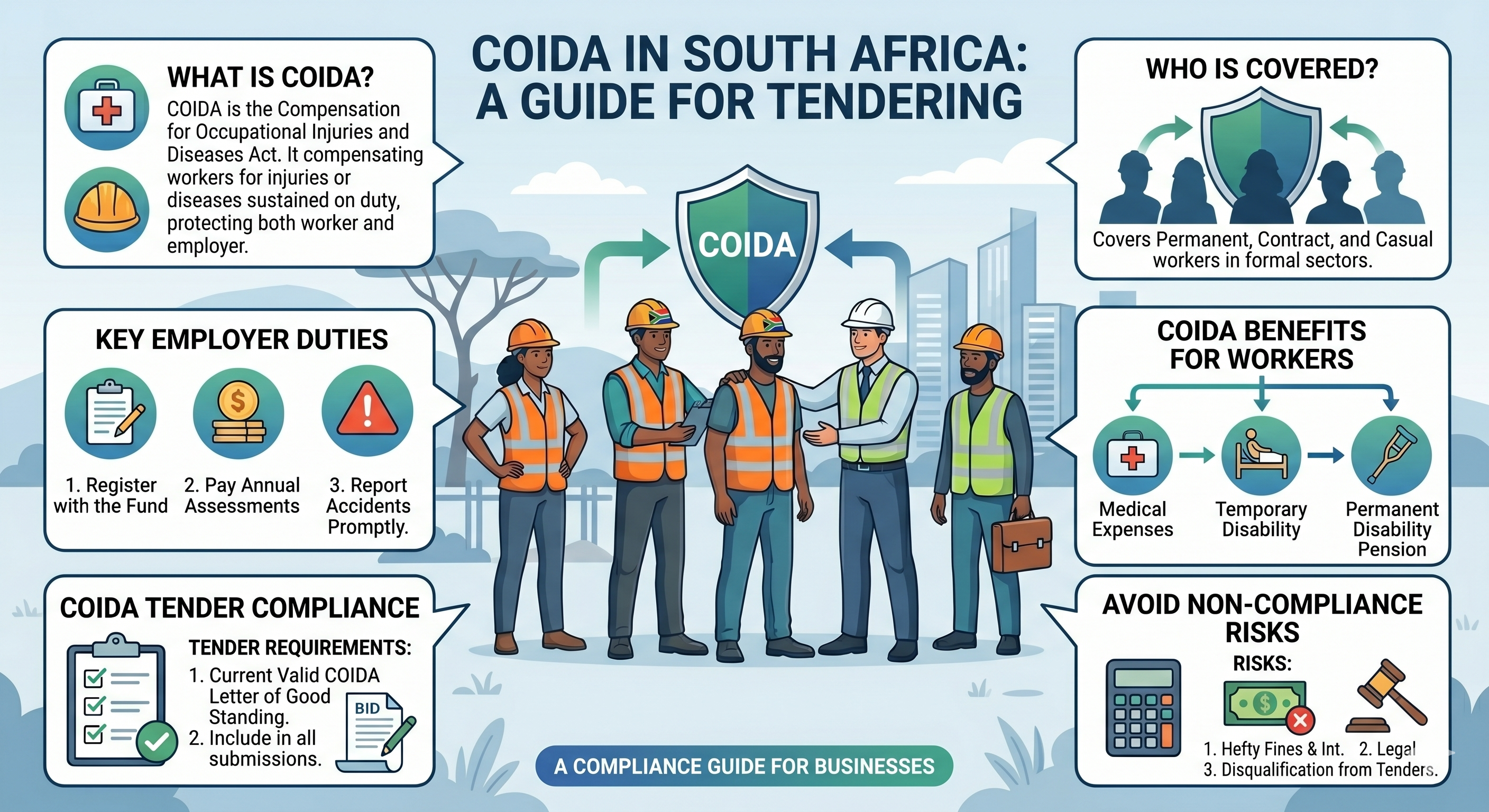
The Compensation for Occupational Injuries and Diseases Act (COIDA) requires every South African employer to register with the Compensation Fund and contribute annually. For contractors bidding on government tenders, a valid COIDA Letter of Good Standing is a mandatory compliance document — without it, your tender submission will be disqualified regardless of price or B-BBEE score.
COIDA covers your employees for workplace injuries, occupational diseases, and death arising from employment. It's not optional. The Department of Employment and Labour enforces registration, and non-compliance carries criminal penalties including fines and imprisonment.
Who must register for COIDA?
Every employer in South Africa who employs one or more workers must register, with limited exceptions:
- All construction contractors — regardless of CIDB grading
- All service providers — cleaning, security, electrical, plumbing, IT, transport
- Sole proprietors with employees — even one casual worker triggers the requirement
- Subcontractors — must hold independent COIDA registration
The only entities exempt are employers covered by other compensation schemes (e.g., ODMWA for mines, certain government departments).
Step-by-step COIDA registration process
- Complete Form W.As.2 (Employer Registration Form) — available from the Department of Employment and Labour or downloadable from labour.gov.za. This form captures your business details, nature of work, number of employees, and estimated annual earnings.
- Submit the form to your nearest Department of Employment and Labour office or via the Compensation Fund's online portal (CompEasy). Include certified copies of your company registration documents (CIPC), director/member ID copies, and proof of business address.
- Receive your employer reference number — the Fund assigns a unique reference number (format: E followed by digits) once registration is processed. This typically takes 2-4 weeks.
- Pay your first assessment — the Fund calculates your annual assessment based on your industry classification and total employee earnings. Construction and security typically attract higher rates due to occupational risk profiles.
- Submit your first Return of Earnings (ROE) — due by 31 March each year, declaring total employee earnings for the previous year. Late submissions attract penalties.
- Apply for your Letter of Good Standing — once your assessment is paid and ROE is submitted, you can request a Letter of Good Standing via the CompEasy portal or your local office.
The Letter of Good Standing: your tender compliance key
The Letter of Good Standing (LoGS) confirms that your assessments are paid and your account is in good standing with the Compensation Fund. This document is required for:
- All government tender submissions (national, provincial, municipal)
- CSD registration and profile updates
- CIDB registration renewals
- Main contractor verification of subcontractors
- Some private sector contracts
The LoGS is typically valid for 12 months from the date of issue. Many contractors make the mistake of submitting an expired letter — this results in immediate disqualification on most tenders.
How to get your Letter of Good Standing
Option 1: CompEasy Online Portal
- Visit the CompEasy portal at labour.gov.za
- Log in with your employer reference number
- Navigate to "Letter of Good Standing" request
- If your account shows zero balance (all assessments paid, ROE submitted), the letter generates immediately
- Download and save as PDF
Option 2: Department of Labour Office
- Visit your nearest DoEL office with your employer reference number
- Request the letter at the counter
- Processing time: same day if account is clear, up to 10 working days if queries exist
Common blockers
- Outstanding assessments: Pay all outstanding amounts before requesting
- Missing ROE: Submit all outstanding Returns of Earnings
- Penalty interest: Late payments attract interest — settle these to clear your account
- Incorrect employer details: Ensure your CIPC details match your Compensation Fund registration
Annual obligations: Return of Earnings (ROE)
Every year by 31 March, you must submit a Return of Earnings declaring the total earnings paid to all employees during the previous year (1 March to 28/29 February). The Compensation Fund uses this to calculate your assessment for the coming year.
What to declare:
- Total gross earnings for all employees (wages, salaries, overtime, bonuses)
- Number of employees per category
- Industry classification codes
Penalties for late submission:
- 10% penalty on assessment amount
- Interest on outstanding amounts
- Your Letter of Good Standing will not be issued until the ROE is submitted and assessment paid
COIDA assessment rates by industry
Assessment rates vary significantly by industry classification. Higher-risk industries pay more:
- Construction (general building): Approximately R1.38 per R100 of earnings
- Construction (civil engineering): Approximately R2.58 per R100 of earnings
- Electrical contracting: Approximately R1.75 per R100 of earnings
- Security services: Approximately R1.04 per R100 of earnings
- Cleaning services: Approximately R0.94 per R100 of earnings
- Office/admin: Approximately R0.19 per R100 of earnings
Note: Rates are updated periodically by the Compensation Fund. Always verify current rates on the official portal.
What happens when an employee is injured?
When a workplace injury or occupational disease occurs:
- Provide immediate medical treatment — the Compensation Fund covers medical expenses for work-related injuries
- Report the incident within 7 days — submit Form W.Cl.2 (Notice of Accident/Occupational Disease) to the Compensation Fund
- The employee claims compensation — for temporary disability (75% of earnings), permanent disability (lump sum or pension), or death benefits (dependants receive pension)
- Your assessment may increase — a poor claims history can result in higher future assessments (experience rating)
COIDA and tender compliance: the full picture
For government tenders, COIDA compliance is one piece of a larger compliance puzzle. A complete tender submission typically requires:
- ✅ COIDA Letter of Good Standing (this guide)
- ✅ CIDB Registration Certificate (for construction)
- ✅ CSD Registration (MAAA number)
- ✅ B-BBEE Certificate or sworn affidavit
- ✅ Tax Clearance Certificate (via SARS eFiling)
- ✅ Company registration documents (CIPC)
- ✅ Completed SBD forms (SBD 1, 3.1, 4, 6.1, 8, 9)
Missing any one of these can disqualify your entire submission. TenderProSA's Compliance Pack feature checks all of these automatically when you upload a tender document — flagging gaps before you submit.
Common COIDA mistakes that cost contractors tenders
- ❌ Expired Letter of Good Standing — request a new one at least 30 days before tender closing dates
- ❌ Not registering subcontractors — main contractors are liable if subcontractors are unregistered
- ❌ Underreporting earnings — the Fund audits ROE declarations; underreporting creates legal risk and potential back-assessments
- ❌ Using a broker letter instead of the Fund letter — some tenders specifically require the Compensation Fund letter, not a private insurer's confirmation
- ❌ Confusing COIDA with private workmen's comp insurance — COIDA registration is a statutory requirement separate from any private insurance policy
How TenderProSA helps with COIDA compliance
TenderProSA's AI reads your tender document and identifies every compliance requirement — including COIDA. Our Compliance Checklist flags whether your Letter of Good Standing is on file, whether it's still valid, and reminds you to renew before expiry. When generating your bid pack, the system includes your COIDA documentation in the correct position within the submission.
Ready to automate your tender compliance? Try TenderProSA free today — upload your first tender and get AI-powered analysis in minutes. 100 credits on signup, no credit card required.