
Method Statements for Tenders: How to Write One That Wins (2026 Guide)
What is a Method Statement and why do evaluators care?
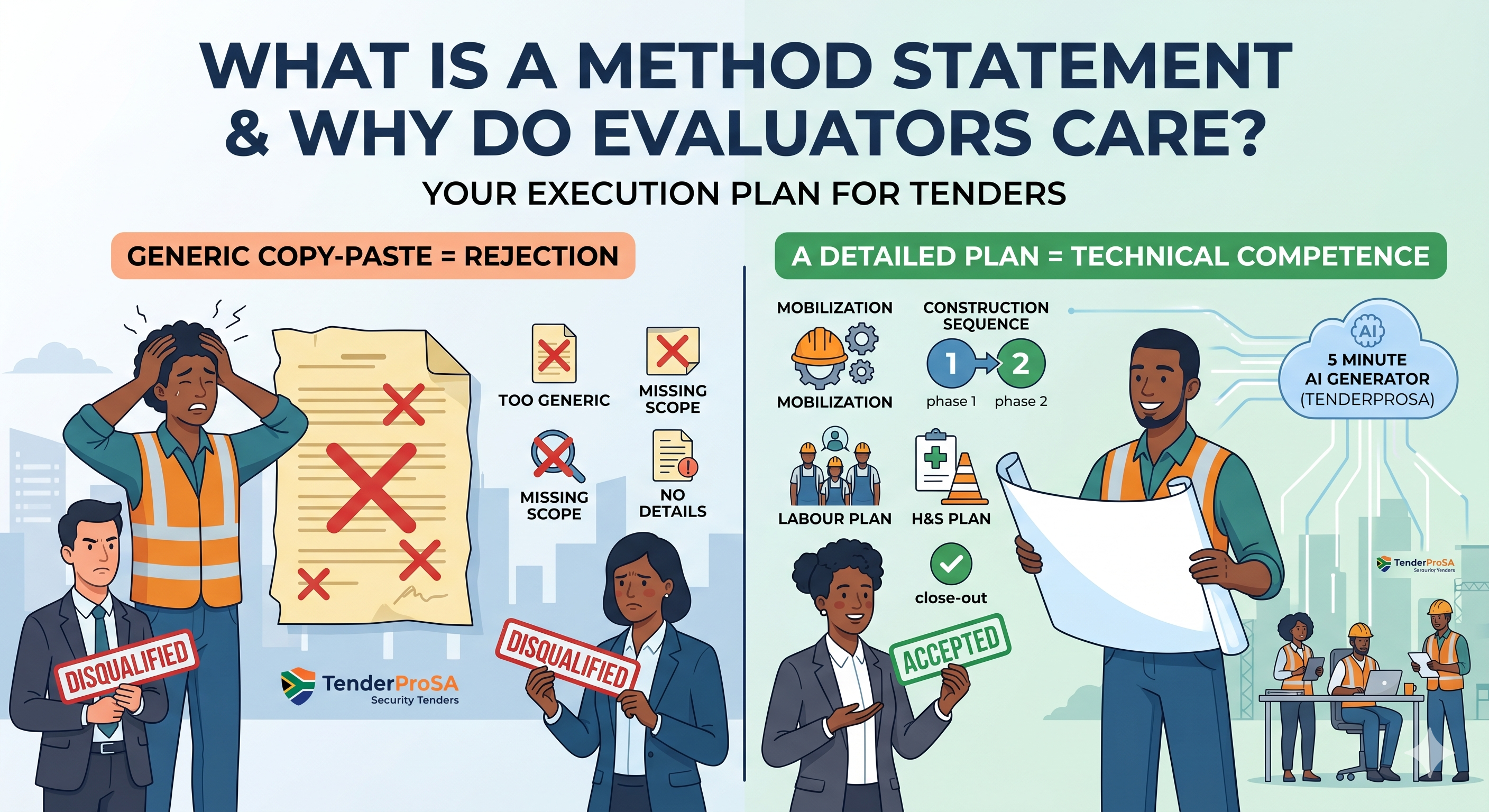
A Method Statement (sometimes called a Methodology or Execution Plan) describes how you will execute the work — step by step, phase by phase. It's your chance to show the evaluating authority that you understand the scope, have a realistic execution plan, and won't wing it on site.
For many government tenders, a poor or missing method statement is grounds for automatic disqualification — even if your price and B-BBEE score are competitive. Evaluators use it to assess technical competence. Treat it as seriously as your pricing.
When is a Method Statement required?
Method Statements are required for:
- All construction and civil engineering tenders
- Electrical, HVAC, and mechanical installation projects
- Cleaning services contracts (describing cleaning frequencies, chemicals, equipment)
- Security services tenders (describing deployment methodology, incident protocols)
- Any tender where the scope involves ongoing service delivery with a defined process
- CIDB Grade 4 and above projects — almost universally required
The 10 sections every winning Method Statement includes
- Project Overview: Summarise the project, your company, and your understanding of the scope
- Mobilisation & Site Establishment: How you'll set up — offices, storage, security, temporary facilities
- Construction/Service Methodology: Phase-by-phase breakdown of how the work will be executed
- Sequence of Activities: Logical order of operations, with why this sequence is optimal
- Equipment & Plant: List of plant, equipment, and tools to be deployed, with quantities
- Materials: Key materials, procurement approach, and quality assurance mechanisms
- Labour Plan: Team structure, skills levels, supervision ratios, and planned hours per activity
- Health & Safety: Site-specific risks, control measures, PPE requirements, emergency procedures
- Environmental & Community: Noise, dust, waste management, effects on surrounding community
- Handover & Close-Out: Testing, commissioning, snag resolution, and documentation handover
Common method statement mistakes
Being too generic
A method statement that could apply to any project anywhere says nothing. Evaluators can tell when you've copy-pasted from a template. Reference specific site conditions, materials called out in the tender document, and local regulations by name (CIDB, COIDA, OHS Act, SANS standards).
Missing the scope
Read the tender document carefully and ensure your method statement covers every significant work item. If the tender calls for a 5km pipeline installation and your method statement only mentions 3km, you've signalled either carelessness or that you haven't read the documents.
No quantities or timelines
A method statement without production rates, crew sizes, or timing is a wish list, not a plan. State how many m² per day your floor team can lay, how many metres per shift your pipe crew can install, and how this aligns with your programme.
H&S section treated as an afterthought
Health and Safety is evaluated as seriously as technical methodology on most public sector projects — especially post the Construction Regulations 2014. Identify site-specific hazards, reference your HIRA, and describe specific control measures. Generic "PPE will be worn" clauses fail evaluations.
Industry-specific considerations
Electrical tenders
Reference SANS 10142-1 (wiring code), MEIBC applicable conditions, testing and commissioning sequences. Include your wireman's licence class and note your compliance with the OHS Act electrical installation regulations.
Cleaning services
Specify cleaning frequencies per area type, chemical products (with MSDS references), equipment specifications, staff deployment schedule, and quality inspection regime. Many evaluators check whether your chemicals comply with Green Star or SANS standards.
Security services
Reference PSIRA registration, Grade C/B/A guard deployment, post orders structure, incident reporting protocols, and control room communication specifications.
Writing a method statement in 5 minutes with AI
Traditionally, a thorough method statement takes 3–4 hours to write from scratch. TenderProSA's AI Method Statement Generator reads your tender document, extracts the scope and site conditions, and generates a complete, formatted method statement in under 5 minutes.
The output covers all 10 required sections, references the tender-specific scope and materials, includes SA-compliant H&S references, and is fully editable. Most contractors review and customise the AI draft in 20–30 minutes, then submit with confidence.
At 20 credits per generation (~R2 per document at Starter Pro pricing), it's the most cost-effective hour you'll save this week.
Try the AI Method Statement Generator free — 100 credits on signup, no card required.