
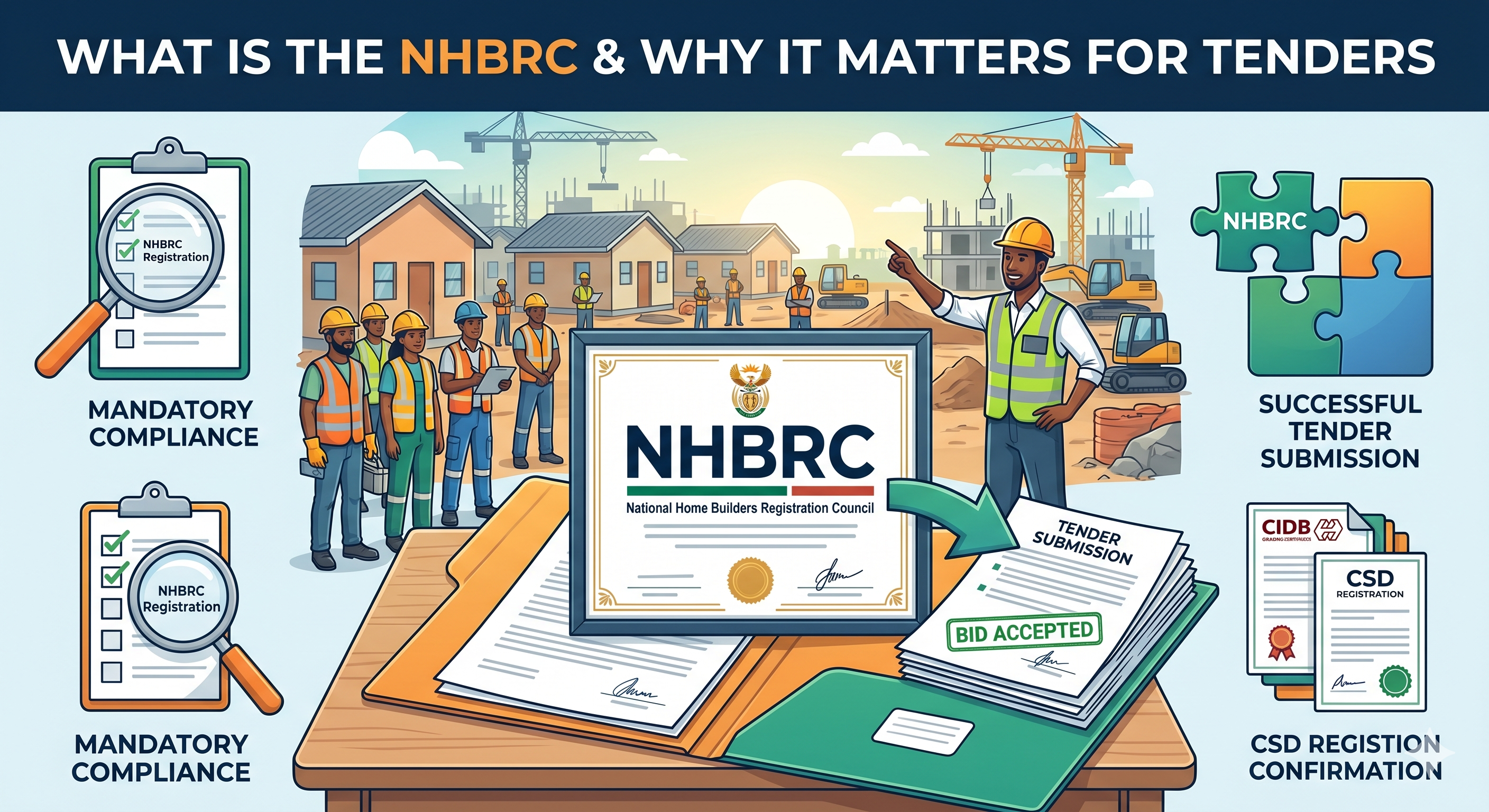
NHBRC Registration for SA Construction Tenders: 2026
What is the NHBRC and why it matters for tenders
The National Home Builders Registration Council (NHBRC) is a statutory body established under the Housing Consumers Protection Measures Act 95 of 1998. If your construction business builds or develops residential properties — including RDP houses, social housing units, bonded housing developments, or mixed-use projects with residential components — you must be registered with the NHBRC before bidding on government contracts involving residential construction.
Failing to include a valid NHBRC registration certificate in your tender submission for an applicable project will result in immediate disqualification. Government housing departments (DHS, provincial housing departments, municipalities) consistently enforce this requirement. This guide walks you through what you need to know.
Who must register with the NHBRC?
NHBRC registration is required for:
- Home builders — any person or entity that constructs new residential dwellings for sale or as part of a government housing contract
- Developers — entities developing residential stands or estates for sale or for government programs
- Contractors on government housing projects — RDP/BNG (Breaking New Ground) housing, social housing, affordable housing, hostels upgrading, informal settlement upgrading with residential units
- Subcontractors on residential projects — increasingly required by main contractors on housing programs
Commercial construction contractors who only build non-residential structures (offices, warehouses, schools, hospitals) do not require NHBRC registration — but the moment a project includes residential dwelling units, the requirement kicks in. Check the tender document carefully.
NHBRC registration categories
The NHBRC registers builders in different categories based on the scale and type of construction:
- Category A — Mass housing contractors: Large-scale government housing programs (100+ units per project). Requires significant financial capacity and track record.
- Category B — Medium contractors: Government housing projects of 20-99 units. Most municipal housing tenders fall in this category.
- Category C — Small contractors: Projects of up to 19 residential units. Emerging contractor programs, EPWP housing, community-based construction.
- Category D — Developer: For entities developing stands/townships rather than directly constructing.
Tender documents specify the minimum NHBRC category required. Bidding below the required category is a disqualifying failure. Always verify the requirement before preparing your submission.
How to register with the NHBRC: step-by-step
- Obtain and complete the application form. Download the NHBRC Builder Registration Application from nhbrc.org.za or collect from the nearest NHBRC regional office. Complete all sections including business details, directors, technical capacity, and financial information.
- Compile supporting documents:
- Certified copy of company registration (CIPC certificate)
- Certified copies of ID documents for all directors/members
- Proof of business address
- Latest financial statements (audited or reviewed, depending on category)
- Tax clearance certificate (TCS PIN)
- CIDB registration certificate (for construction categories)
- CV and qualifications of the responsible person/technical director
- List of previously completed residential projects with references
- Bank statements (last 3-6 months, showing financial capacity)
- Pay the registration fee. NHBRC charges a non-refundable application fee and an annual registration fee that varies by category. Fees are updated periodically — check the current schedule on the NHBRC website before submitting. Payment is by EFT to the NHBRC account.
- Submit your application to the nearest NHBRC regional office. The NHBRC has offices in all provinces. Bring originals plus certified copies on the day of submission.
- NHBRC assessment. The NHBRC assesses your technical capacity, financial standing, and compliance history. They may inspect past projects or request additional documentation. Category A assessments are more rigorous than Category C.
- Receive your registration certificate. Once approved, the NHBRC issues a registration certificate with your unique builder number. This certificate must be included in all applicable tender submissions.
Annual renewal and continuing obligations
NHBRC registration must be renewed annually. Continuing obligations include:
- Annual renewal fee: Payable before the anniversary of your registration date
- Updated financial statements: Submitted annually to demonstrate ongoing financial viability
- Home enrolments: Every residential unit you build must be enrolled with the NHBRC before construction commences (not just registered as a business — each project/unit is separately enrolled)
- Warranty fund levies: For each enrolled unit, you pay a levy into the NHBRC Warranty Fund. This fund covers the 5-year structural warranty provided to housing consumers.
- Defect rectification: If enrolled units develop covered defects within the warranty period, you must rectify them. Failure to do so can result in suspension of your NHBRC registration.
The NHBRC home enrolment process
Registration with the NHBRC as a builder is separate from enrolling individual projects. Every residential unit you construct must be enrolled before breaking ground:
- Submit an enrolment application for the project (or individual unit for small projects)
- Pay the enrolment levy (calculated per unit based on the contract value)
- NHBRC issues an enrolment number for the project
- NHBRC conducts inspections at key construction stages (foundation, wall plate, roof)
- On completion, NHBRC issues a home enrolment certificate for each unit
For government housing tenders, the contracting authority typically requires proof of enrolment at the time of site handover. Build the enrolment levy cost into your pricing — it is a direct project cost.
NHBRC and the government housing tender landscape
Government housing construction is a significant tender market in South Africa. Key programs requiring NHBRC compliance include:
- BNG (Breaking New Ground) / RDP housing: National and provincial housing departments, largest volume program
- Social housing: Social Housing Regulatory Authority (SHRA) funded projects
- Community Residential Units (CRU): Hostel upgrading and community housing programs
- FLISP (Finance Linked Individual Subsidy Programme): Affordable housing with subsidy component
- Military Veterans Housing: Department of Military Veterans housing projects
- Municipal housing programs: City and district municipality housing delivery
All of these require NHBRC-registered contractors. The CIDB grading requirement runs parallel to NHBRC — you typically need both for government housing work.
Common NHBRC compliance failures in tenders
- ❌ Expired registration certificate — annual renewal is mandatory; check your expiry date before every submission
- ❌ Wrong category for the tender — bidding with Category C registration on a 50-unit project requiring Category B
- ❌ Not enrolling units before construction — starting on site without enrolment is a criminal offence under the Act
- ❌ Forgetting to price enrolment levies — a pricing error that eats directly into your margin
- ❌ Registration in individual name, not company name — if the tender requires a registered company, an individual NHBRC registration may not satisfy the requirement
NHBRC, CIDB, and the full compliance picture for housing tenders
A complete government housing tender submission requires:
- ✅ NHBRC registration certificate (correct category) — this guide
- ✅ CIDB registration at required grade (typically GB or CE)
- ✅ CSD registration (MAAA number active)
- ✅ B-BBEE certificate
- ✅ Tax clearance TCS PIN
- ✅ COIDA Letter of Good Standing
- ✅ Completed SBD forms (SBD 1, 3.1, 4, 6.1, 8, 9)
- ✅ Method statement and health and safety plan for the project
TenderProSA automatically checks all compliance requirements when you upload a housing tender document — and generates your full method statement, HIRA, and SBD forms as part of the bid pack.
Ready to win more housing construction tenders? Try TenderProSA free — upload your first tender and get AI-powered compliance checking, pricing, and document generation in under 20 minutes. 100 credits on signup, no credit card required.