
PSIRA Registration for SA Security Tenders: 2026 Guide
Why PSIRA registration is non-negotiable for security tenders
If your business provides any form of private security services in South Africa — armed response, guarding, access control, cash-in-transit, or alarm monitoring — you must be registered with the Private Security Industry Regulatory Authority (PSIRA). Without a valid PSIRA certificate, your security tender submission will be disqualified regardless of price or B-BBEE level.
PSIRA was established under the Private Security Industry Regulation Act 56 of 2001 and is the sole regulatory body for the private security industry in South Africa. Registration is mandatory for both security businesses and individual security officers. This guide focuses on what security businesses need to know when bidding on government tenders.
Who must register with PSIRA?
PSIRA registration is required for any person or business that:
- Provides security services for reward, whether directly or indirectly
- Carries on the business of supplying security officers to clients
- Trains security officers or manages a security training facility
- Provides locksmith services, private investigations, or body guarding services
- Supplies or installs security technology (alarm systems, CCTV, access control) as part of a security service package
If your company cleans government facilities but also provides after-hours security personnel, the security component requires PSIRA registration. Main contractors who subcontract security services must ensure their subcontractors are also PSIRA-registered — procuring entities check this during contract execution.
PSIRA grades: what they mean for tenders
PSIRA registers security businesses in different grades based on the type of services provided. Understanding the grading structure is critical for tender compliance:
Security Service Provider (SSP) grades
- Grade A: Highest grade — companies providing the full range of security services including cash-in-transit, armed response, and complex installations. Most large government security tenders require Grade A.
- Grade B: Standard guarding, access control, patrol services. Suitable for most municipal and provincial guarding contracts.
- Grade C: Entry-level guarding services, typically unarmed security officers. Limited scope — unsuitable for most government tenders requiring armed response or specialized services.
- Grade D (In-house): Businesses registering their own employed security staff for internal use — not for commercial security service provision.
Always check the tender document for the required PSIRA grade. Bidding with a lower grade than specified is a disqualifying compliance failure.
Individual security officer grades
Your security officers must also be individually registered with PSIRA. The officer grading affects what duties they can lawfully perform:
- Grade E: Entry-level, unarmed, limited powers
- Grade D: Unarmed security officer, standard duties
- Grade C: Armed security officer (SAPS firearm competency required)
- Grade B: Senior armed officer, supervisor
- Grade A: Security manager, control room operator
Government tenders increasingly specify minimum officer grades for deployed personnel. Check staffing requirements before submitting your pricing — deploying under-graded officers during contract execution is a serious regulatory violation.
How to register your security business with PSIRA: step-by-step
- Obtain your company registration documents. You need a valid CIPC registration certificate, proof of company address, and details of all directors/members/shareholders.
- Compile the PSIRA business registration application. Download Form 1 (Application for Registration as a Security Service Provider) from the PSIRA website at psira.co.za. Complete all sections including the grade(s) you are applying for.
- Prepare supporting documents:
- Certified copies of ID documents for all directors/members
- Proof of business address (municipal rates account or signed lease)
- Company organogram showing ownership structure
- SAPS clearance certificates for all directors (no criminal record for scheduled offences)
- Proof of compliance with minimum wage requirements (PSIRA wage schedule)
- Proof of employment contracts for security officers if already employing staff
- Pay the registration fee. PSIRA charges annual registration fees based on the size of your business (number of employed security officers). Fees are reviewed annually — check the current fee schedule on the PSIRA website. Payment is made by EFT to PSIRA's bank account; proof of payment must accompany your application.
- Submit your application to the nearest PSIRA regional office or via post to the PSIRA head office in Centurion. Applications can also be submitted electronically via the PSIRA online portal.
- PSIRA processes and inspects. PSIRA may conduct a compliance inspection before issuing registration. Inspectors check business premises, employment records, officer registration status, and compliance with the PSIRA wage schedule.
- Receive your PSIRA certificate. Once approved, PSIRA issues a registration certificate specifying your grade and validity period (annual renewal). Keep this certificate readily available for tender submissions.
Annual renewal: keeping your PSIRA certificate current
PSIRA registration must be renewed annually. The renewal process requires:
- Submission of a renewal application form
- Updated list of all employed and deployed security officers (with their individual PSIRA registration numbers)
- Proof of compliance with the current PSIRA wage schedule
- Payment of annual renewal fees
- Updated SAPS clearance certificates if any directors have changed
A lapsed PSIRA certificate is one of the most common reasons security companies are disqualified from tenders. Set a calendar reminder 60 days before your renewal date — the process can take 3-6 weeks if there are any queries.
The PSIRA wage schedule: compliance requirement for tenders
The PSIRA wage schedule (updated annually, typically in February) sets minimum wages for security officers by grade. Compliance with the wage schedule is a condition of PSIRA registration and a tender requirement for most government security contracts. Key points:
- Wages are set per grade and per shift type (day, night, public holiday)
- Under-paying security officers is a PSIRA violation and can result in deregistration
- Tender evaluators check that your pricing reflects at minimum the PSIRA wage rates for the number of officers and hours specified
- Pricing below PSIRA minimum rates is a red flag — evaluators may request a pricing breakdown or reject your bid for undue risk
When pricing a security tender using TenderProSA's pricing calculator, the system includes current PSIRA wage schedule rates in the labour cost calculation — so your pricing is automatically PSIRA-compliant.
PSIRA compliance for joint ventures and subcontracting
Security tenders awarded to joint ventures require all JV parties providing security services to hold valid PSIRA registration. Subcontracting security services to an unregistered entity during contract execution is a criminal offence under the Private Security Industry Regulation Act. Main contractors bear responsibility for subcontractor compliance — verify PSIRA registration before appointing any security subcontractor.
Common PSIRA compliance failures in tenders
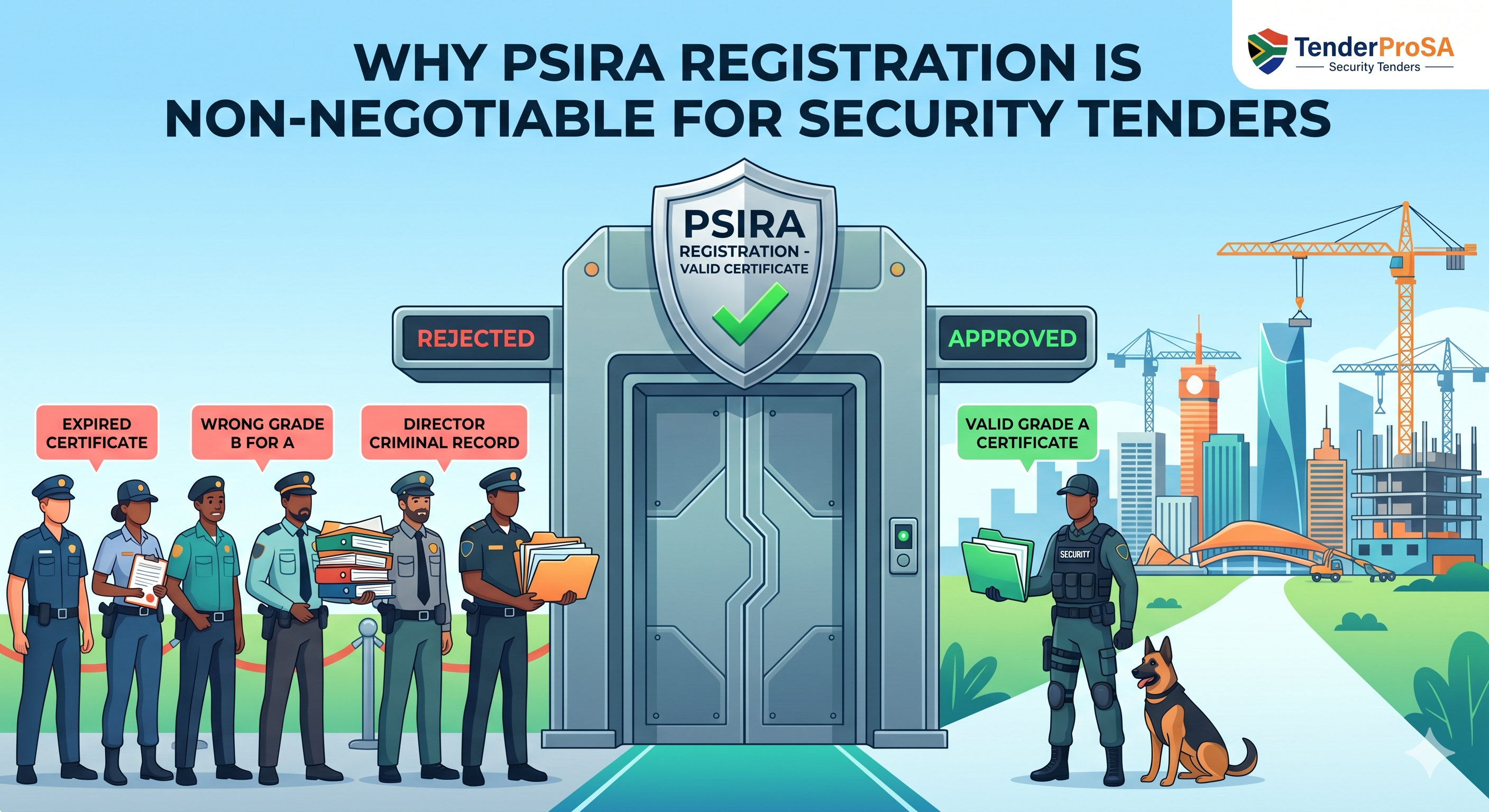
- ❌ Expired PSIRA certificate — the most common disqualification. Annual renewal is non-negotiable.
- ❌ Wrong grade for the tender — bidding with Grade B registration for a Grade A tender requirement
- ❌ Directors with disqualifying criminal records — PSIRA prohibits registration if directors have been convicted of certain offences. SAPS clearance certificates must be current.
- ❌ Non-compliant wage schedule pricing — pricing security officers below minimum PSIRA wages. Evaluators flag this and may request justification or disqualify.
- ❌ Unlisted security officers — deploying officers not reflected on your PSIRA business registration creates liability during contract execution audits.
PSIRA, CSD, and the full compliance picture
For government security tenders, PSIRA certification is one part of your compliance pack. A complete submission also requires:
- ✅ PSIRA business registration certificate (this guide)
- ✅ Individual PSIRA registration for all officers specified in your tender staffing plan
- ✅ CSD registration with PSIRA details linked
- ✅ B-BBEE certificate (security sector codes apply)
- ✅ Tax clearance (TCS PIN)
- ✅ COIDA Letter of Good Standing
- ✅ Completed SBD forms (SBD 1, 3.1, 4, 6.1, 8, 9)
TenderProSA's Compliance Pack automatically checks all of these when you upload a security tender document — flagging gaps before you submit.
How TenderProSA helps security companies win more tenders
Security tenders are highly competitive, price-sensitive, and compliance-heavy. TenderProSA's AI reads your tender document and extracts every requirement — PSIRA grade, officer grades, hours, shift types, wage schedule compliance, SBD forms needed — in minutes rather than hours. The pricing engine uses current PSIRA wage schedule rates to build a compliant, competitive price automatically.
Ready to win more security tenders? Try TenderProSA free today — upload your first security tender and get AI-powered analysis, compliance checking, and pricing in under 20 minutes. 100 credits on signup, no credit card required.