
SABS Certification for Government Tenders 2026
What is SABS Certification and Why It Matters for Tenders
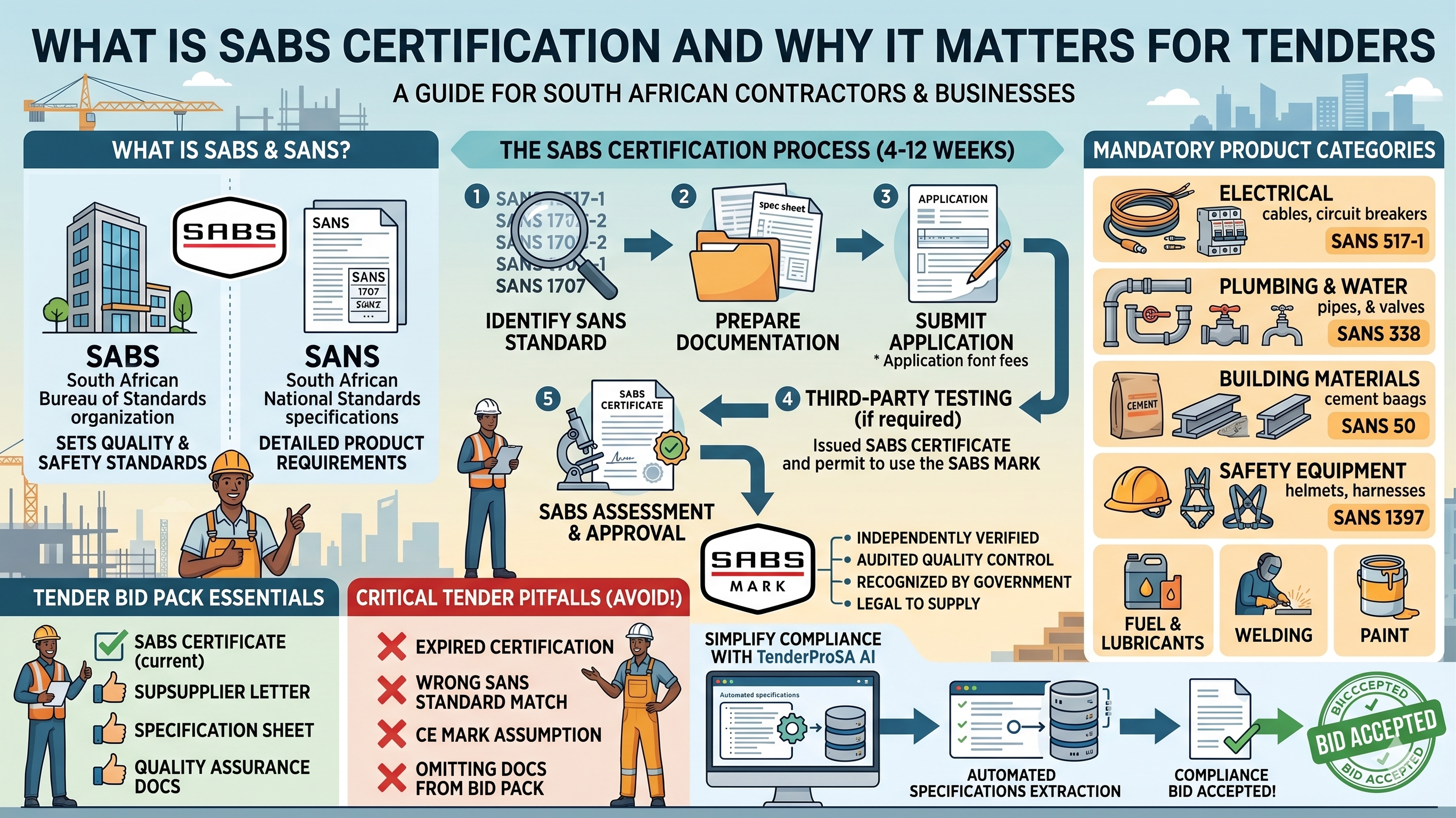
The South African Bureau of Standards (SABS) is the national standards body responsible for setting and enforcing safety, quality, and performance standards for products and services across South Africa. When you bid for government tenders, SABS certification is often a non-negotiable requirement — especially in construction, manufacturing, electrical, plumbing, and industrial sectors.
Many contractors lose tenders not because their pricing is poor or their team is inexperienced, but because their products or services lack the required SABS certification. This is a disqualification reason that no price advantage can overcome. Understanding SABS requirements early in your tender preparation can mean the difference between a winning bid and a rejected submission.
Which Products and Services Require SABS Certification
Not every product needs SABS certification, but certain categories are mandatory for government procurement. Government bodies use SANS (South African National Standards) in their tender specifications to ensure quality and safety.
Products commonly requiring SABS certification for tenders include:
- Electrical equipment (cables, circuit breakers, transformers, panels)
- Plumbing and water systems (pipes, fittings, valves, pumps)
- Building materials (cement, steel, insulation, windows)
- Safety equipment (harnesses, helmets, protective gear)
- Fuel and lubricants (diesel, petrol, engine oils)
- Welding materials and equipment
- Paint and coatings
- Water treatment chemicals
- Fire suppression systems
- HVAC and ventilation equipment
The safest approach: if a tender specification lists a SANS standard number (like SANS 50001 or SANS 517-1), SABS certification is mandatory. Bidding without it will result in automatic rejection — the tender evaluation team has no discretion to waive this requirement.
Understanding SANS Standards and Product Classifications
SANS (South African National Standards) are the technical specifications that define product requirements. When a government tender says "supply must comply with SANS 1707 for structural steel," that means your steel supplier must provide SABS-certified products meeting that exact standard.
Common SANS standards for infrastructure and construction tenders:
- SANS 50:2011 — Cement and concrete
- SANS 282 — Steel reinforcement
- SANS 517-1 — Electrical installations in buildings
- SANS 60898 — Electrical circuit breakers
- SANS 338 — Water pipes and fittings
- SANS 1307 — Paint and varnish
- SANS 1707 — Structural steel
SABS maintains a comprehensive database of certified products and suppliers. Before bidding, check the SABS website product certification database to confirm your supplier holds valid certification for the specific SANS standard required by the tender.
How to Obtain SABS Certification for Your Products
The process depends on whether you manufacture products locally or import them. Getting SABS certification typically takes 4-12 weeks, so plan ahead if you are entering a new product category for government tenders.
Step 1: Identify the Applicable SANS Standard
Contact SABS or search their technical committee list to find the SANS standard that applies to your product. Different product categories have different standards, and using the wrong one will delay certification.
Step 2: Prepare Product Documentation
Gather technical specifications, test reports, manufacturing procedures, quality control documentation, and safety data sheets. SABS will review these to assess compliance with the SANS standard.
Step 3: Submit Application to SABS
Complete the SABS certification application form and submit it with your technical documentation. There is an application fee (typically ZAR 2,000–5,000 depending on product complexity).
Step 4: Third-Party Testing (if required)
For certain product categories, SABS requires independent laboratory testing. This can cost ZAR 10,000–50,000+ depending on the product. Common testing includes tensile strength, electrical safety, chemical composition, and environmental resistance.
Step 5: SABS Assessment and Approval
SABS technicians review your documentation and test results. If everything meets the standard, they issue a SABS certification mark (the SABS logo on your product packaging or documentation). This is valid for 3 years and can be renewed.
For imported products, your overseas supplier typically handles SABS certification in their country. You then apply for SABS Approval (for Imported Products), which is faster (2-4 weeks) and requires less documentation.
The SABS Mark: What It Means and How It Protects Your Tender Bid
When a product displays the official SABS certification mark (a hexagon with SABS inside), it means:
- The product has been independently tested and verified to meet the relevant SANS standard
- The manufacturer s quality control processes have been audited and approved
- The certification is recognized by all South African government procurement bodies
- The product is legal to supply in government tenders requiring that standard
Including SABS certification documentation in your tender submission signals to the evaluation team that you have done your homework and are compliant. This strengthens your bid and reduces the risk of disqualification on technical grounds.
Pro tip: If you are using TenderProSA's AI-powered tender analysis, the platform automatically extracts SANS standard requirements from tender documents, so you know exactly which certifications you need before preparing your bid.
Common SABS Certification Mistakes to Avoid
Mistake 1: Assuming Old Certification Is Still Valid
SABS certifications expire after 3 years. If your product certification expired 6 months ago, you cannot bid with it. Check your certificate expiry date and renew if needed.
Mistake 2: Getting the Wrong Certification
A product certified under SANS 1707 (steel) is not certified under SANS 282 (reinforcement bars) — each standard is specific. Read the tender specification carefully and match it exactly.
Mistake 3: Assuming CE Marked Is Equivalent
CE marking (European standard) is not the same as SABS certification. South African government tenders require SABS specifically. CE marking will not help you.
Mistake 4: Not Including Certification in Your Bid Pack
Even if your supplier has SABS certification, if you do not include a copy in your tender submission, the evaluators may reject you for non-compliance. Always attach SABS certificates to your bid.
Mistake 5: Ignoring Minor Standard Updates
SANS standards are updated periodically. If a tender specifies SANS 517-1:2020 and your certification is for SANS 517-1:2011, clarify with the tender issuer whether the older certification is acceptable. Sometimes it is, sometimes it is not.
What to Include in Your Tender Submission
When bidding on a tender requiring SABS certification, include these documents in your bid pack:
- SABS Certificate — original or certified copy showing your product name, certification number, standard, and expiry date
- Letter from Supplier — confirmation that they hold current SABS certification and will supply only certified products
- Product Specification Sheet — showing compliance with the relevant SANS standard (e.g., tensile strength, electrical resistance, dimensions)
- Quality Assurance Documentation — proof of your organization is quality control processes
Organize these documents in a dedicated section of your tender response so evaluators can quickly verify compliance.
How TenderProSA Simplifies SABS Compliance
TenderProSA is AI extracts all SANS standard requirements directly from tender documents, highlighting which certifications you need before you start preparing your bid. Instead of manually reading 50-page tender documents to find buried specification requirements, the platform:
- Identifies all SANS standards mentioned in the tender
- Flags certification requirements as mandatory or preferred
- Links to SABS product certification database for verification
- Includes certification checklist in your automated bid pack
This reduces the risk of missing a critical compliance requirement and getting disqualified.
Key Takeaways: SABS Certification and Your Tender Success
SABS certification is not optional for government tenders — it is a gate-keeping requirement. Here is what you need to know:
- Government tenders reference specific SANS standards; products must be SABS-certified to that standard
- Certification takes 4-12 weeks to obtain, so plan ahead if entering new product categories
- SABS certificates expire after 3 years — keep them current
- Always include certification documents in your tender submission
- Use TenderProSA to automatically extract SANS requirements from tender documents and avoid missed compliance issues
Ready to automate your tender compliance process? Try TenderProSA free today — upload your first tender and get AI-powered analysis of all SANS and certification requirements in minutes. No more guessing about what your bid needs to include.