
How to Price a Bill of Quantities in SA (2026)
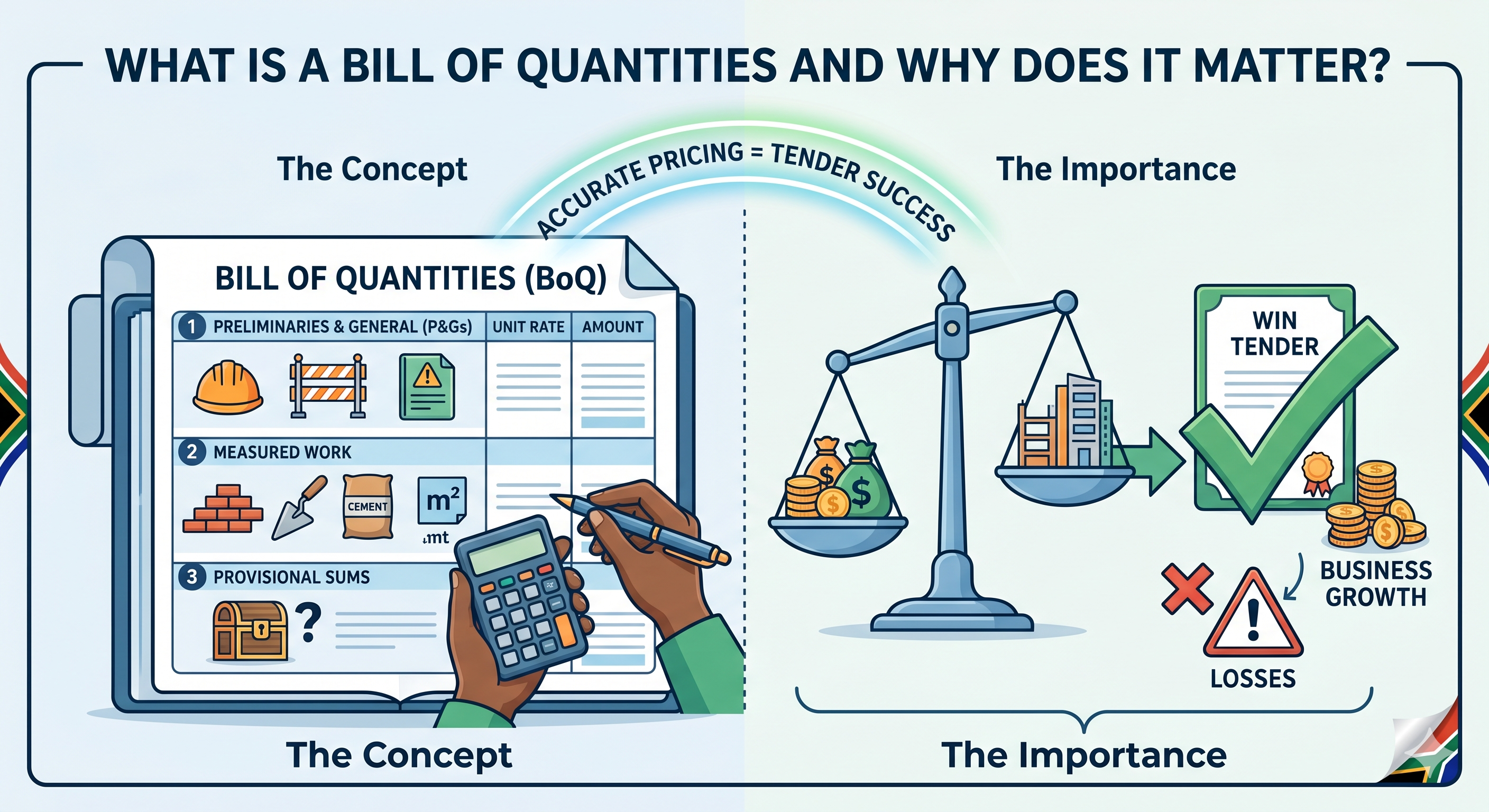
What Is a Bill of Quantities and Why Does It Matter?
A Bill of Quantities (BoQ) is a structured document that lists every material, labour item, and activity required to complete a construction project. In South African government tenders, the BoQ is typically prepared by a Quantity Surveyor (QS) acting for the employer and issued as part of the tender documents. Your job as the contractor is to price each line item — and the total determines whether you win the bid.
Getting your BoQ pricing right is arguably the single most important step in the tender process. Price too high and you lose the contract. Price too low and you win a job that bleeds money. According to the Association of South African Quantity Surveyors (ASAQS), pricing errors are the #1 reason contractors face financial difficulty on government projects.
This guide walks you through the full BoQ pricing process — from understanding the document structure to calculating your final tender price — with a focus on South African regulations, CIDB requirements, and practical tips for SMMEs.
Understanding the BoQ Structure
Before you price a single line, you need to understand how a South African BoQ is organised. Most government tenders follow the Standard System of Measuring Building Work or the Civil Engineering Standard Method of Measurement (CESMM). The BoQ typically contains these sections:
- Preliminaries & General (P&Gs): Site establishment, management, insurance, temporary works, health and safety compliance. These are your fixed project costs that don't relate to specific measured work.
- Measured Work: The core of the BoQ. Each item has a description, unit of measurement (m, m², m³, nr, kg), and quantity. You provide the rate and amount.
- Provisional Sums: Amounts set aside by the employer for work that can't be fully defined at tender stage — specialist installations, contingencies, or nominated subcontractors.
- Daywork Schedule: Rates for labour, plant, and materials that may be needed for unforeseen work on a time-and-materials basis.
Read the entire BoQ before pricing anything. Cross-reference it with the drawings, specifications, and conditions of contract. Missing a note in the preambles can cost you thousands.
Step 1: Calculate Your Direct Costs
Direct costs are the materials, labour, and plant/equipment needed to physically do the work. This is where most of your tender price sits.
Materials
For every measured item, identify exactly what materials are needed:
- Get current supplier quotes — not last year's prices. Material costs in South Africa fluctuate significantly, especially steel, cement, and copper.
- Factor in delivery costs to the project site. A Limpopo site has very different logistics costs than a Sandton project.
- Add a waste allowance — typically 5-10% depending on the material and work type.
- Check if the tender specifies particular brands or standards (e.g., SABS-approved materials). Using non-compliant materials is grounds for rejection.
Labour
Calculate labour costs based on:
- Sectoral Determination wages — the Department of Employment and Labour publishes minimum wages for the construction sector. As of 2026, rates vary by area (Area A, B, and C) and skill level.
- Productivity rates — how much work a team can complete per day. This comes from experience. A bricklayer in Johannesburg might lay 400 bricks/day; factor in weather delays for coastal sites.
- Labour burdens — UIF contributions (1%), COIDA levies, leave pay, and any bargaining council levies. These add 25-35% on top of the basic wage.
Plant and Equipment
For items requiring machinery (excavators, cranes, concrete pumps), price based on:
- Hire rates from local plant hire companies, or internal ownership costs (depreciation + fuel + maintenance)
- Mobilisation and demobilisation costs to get equipment to and from site
- Operator costs if not included in the hire rate
Step 2: Add Preliminary and General Costs
P&Gs cover everything you need to run the project that isn't directly measured work. In South African tenders, P&Gs typically range from 10% to 20% of the measured work value, depending on project complexity and duration.
Key P&G items to price:
- Site establishment: offices, storage, fencing, signage, ablution facilities
- Project management: site agent, foreman, safety officer salaries for the project duration
- Health and safety compliance: PPE, safety files, risk assessments, fall protection, first aid — all required under the OHSA Construction Regulations 2014
- Insurance: contract works insurance, public liability, professional indemnity
- Bonds and guarantees: construction guarantees (typically 10% of contract value) and retention
- Water and electricity: temporary connections and consumption during construction
- Quality control: testing, inspections, and compliance documentation
A common mistake is underpricing P&Gs to make the total look competitive. This backfires — you end up absorbing these costs from your profit margin.
Step 3: Calculate Overheads and Profit
Your overhead recovery and profit margin are what keep your business alive between projects.
Company Overheads
These are your business running costs that aren't project-specific:
- Office rent, admin staff salaries, accounting fees
- CIDB registration and annual fees
- Vehicle costs, communication, IT systems
- Marketing and tender preparation costs (yes, the cost of preparing tenders is a real overhead)
Calculate your annual overhead, then allocate a percentage to each tender based on expected project duration and value. Most SA contractors use 8-15% of project value as an overhead recovery rate.
Profit Margin
Your profit margin depends on:
- Market conditions — in a competitive market, margins may be as low as 5%. In a specialised niche with fewer competitors, 10-15% is achievable.
- Project risk — high-risk projects (complex scope, tight timelines, remote locations) warrant higher margins.
- Your CIDB grading — higher grades mean access to larger tenders with potentially better margins.
A realistic combined overhead + profit margin for most SA SMME contractors is 15-25% on top of direct costs and P&Gs.
Step 4: Apply Risk and Contingency Buffers
Every tender carries risk. The question is whether you price for it or absorb it when things go wrong.
Common risks to price for in South African projects:
- Material price escalation: For contracts longer than 6 months, include a Contract Price Adjustment (CPA) clause or build in a materials escalation buffer of 3-8% depending on market volatility.
- Late payment: Government departments are notorious for slow payment. Factor in your cost of financing (bridging finance interest) for the expected payment delay — often 60-90 days beyond the 30-day contractual term.
- Scope creep: Especially on refurbishment and maintenance contracts where hidden conditions are common. A 3-5% contingency is standard.
- Weather delays: Particularly relevant for electrical and civil works in KZN and the Western Cape during rainy seasons.
- Subcontractor performance: If you're using subcontractors for specialised work, add a management and risk margin on their quoted rates.
Your total risk buffer typically adds 3-8% to the tender price. Don't hide it — experienced QS evaluators can tell when contingency is buried in inflated unit rates.
Step 5: Review, Check, and Submit
Before you finalise your BoQ pricing:
- Cross-check quantities: Verify the employer's quantities against the drawings. If you find errors, follow the tender's instructions for queries — usually a formal clarification to the procurement office before the closing date.
- Check arithmetic: Every rate × quantity = amount. Every section subtotal rolls up correctly. Arithmetic errors are embarrassing and can be grounds for tender rejection under some procurement frameworks.
- Compare against benchmarks: Your total should be within a reasonable range of industry norms. If your price is 40% below the QS estimate, something is wrong. If it's 40% above, you won't be competitive.
- Ensure PPPFA compliance: Under the Preferential Procurement Policy Framework Act, tenders are evaluated on price (80 or 90 points) and B-BBEE preference (20 or 10 points). Know your B-BBEE level and calculate whether you can afford to price slightly higher if your preference points compensate.
- Complete all SBD forms: Your BoQ is only one part of the submission. Ensure SBD 1, 3.1, 4, 6.1, 8, and 9 are completed correctly. Missing forms = automatic disqualification.
- Sign and stamp: Every page of the BoQ must typically be initialled, with the summary page signed by an authorised representative.
Common BoQ Pricing Mistakes That Cost SA Contractors
After working with hundreds of South African contractors, these are the mistakes we see most often:
| Mistake | Impact | How to Avoid |
|---|---|---|
| Using outdated material prices | Underpricing by 10-20% on steel/copper items | Get fresh quotes within 2 weeks of tender closing |
| Ignoring labour burden costs | 25-35% cost underestimation on labour | Always add UIF, COIDA, leave pay, bargaining council levies |
| Underpricing P&Gs | Profit erosion from day one of contract | Price every P&G line item individually, not as a lump sum percentage |
| No escalation provision | Losses on contracts >6 months due to inflation | Include CPA formula or build in 3-8% escalation buffer |
| Arithmetic errors in BoQ | Tender rejection or unintended pricing | Use software or get a second person to verify every calculation |
| Not reading the preambles | Missing special conditions that affect rates | Read the entire BoQ document before pricing any line item |
How TenderProSA Automates BoQ Pricing
Pricing a BoQ manually — pulling supplier quotes, calculating labour rates, adding overheads, checking arithmetic — takes most contractors 2-5 days per tender. When you're bidding on multiple tenders per month, that's weeks of work.
TenderProSA's AI-powered platform automates the heavy lifting:
- Upload your tender documents — BoQ, drawings, specifications. The AI extracts every line item automatically.
- Market-benchmarked rates — get current material and labour rates benchmarked against SA market data. Adjust per region and project conditions.
- Automatic calculations — overheads, profit margins, risk buffers, and PPPFA scoring calculated instantly. No more spreadsheet errors.
- One-click bid pack generation — priced BoQ, method statements, risk assessments, and compliance documents all generated together.
Whether you're a Grade 1 contractor bidding on your first R200,000 project or a Grade 7 operation pricing multi-million rand tenders, the process is the same — just faster.
Frequently Asked Questions
What is a bill of quantities in South African tenders?
A bill of quantities (BoQ) is a detailed list of materials, labour, and work items needed to complete a construction project. In SA government tenders, the BoQ is prepared by the employer's Quantity Surveyor and issued to bidders to price. Your total BoQ price forms the basis of the financial evaluation under the PPPFA points system.
How do I calculate labour rates for a BoQ?
Start with the Sectoral Determination minimum wages for the construction sector (published by the Department of Employment and Labour). Add labour burden costs: UIF (1%), COIDA levies, leave pay provisions, and bargaining council contributions. Then divide by your expected productivity rate to get a cost per unit of work. Total burden typically adds 25-35% to the basic wage.
What percentage should I add for overheads and profit?
Most South African SMME contractors add 15-25% combined overheads and profit on top of direct costs. Company overheads (office, admin, registrations, vehicles) typically account for 8-15%, while profit margins range from 5-15% depending on market competition and project risk.
How do I handle provisional sums in a BoQ?
Provisional sums are set by the employer — you don't price them. They're fixed amounts included in the BoQ for work that can't be fully specified at tender stage. However, you should add your overhead and profit percentage to provisional sums, and price any attendance or facilitation items associated with them.
What happens if there are errors in the employer's BoQ quantities?
If you find quantity errors before the tender closes, submit a formal clarification request to the procurement office by the deadline specified in the tender documents. If errors are discovered after award, they're typically dealt with through the re-measurement process during construction — the contract sum is adjusted based on actual quantities measured on site.
Can software help me price a BoQ faster?
Yes. Manual BoQ pricing takes 2-5 days per tender. AI-powered tools like TenderProSA can extract line items from uploaded tender documents, apply market-benchmarked rates, and calculate your total price with overheads, margins, and risk buffers in minutes. This lets you bid on more tenders without increasing your admin overhead.
Ready to price your next BoQ in minutes instead of days? Try TenderProSA free today — upload your tender documents and get AI-powered BoQ pricing with market-benchmarked rates.