
Electrical Tenders South Africa 2026: A Complete Guide
What Are Electrical Tenders in South Africa?
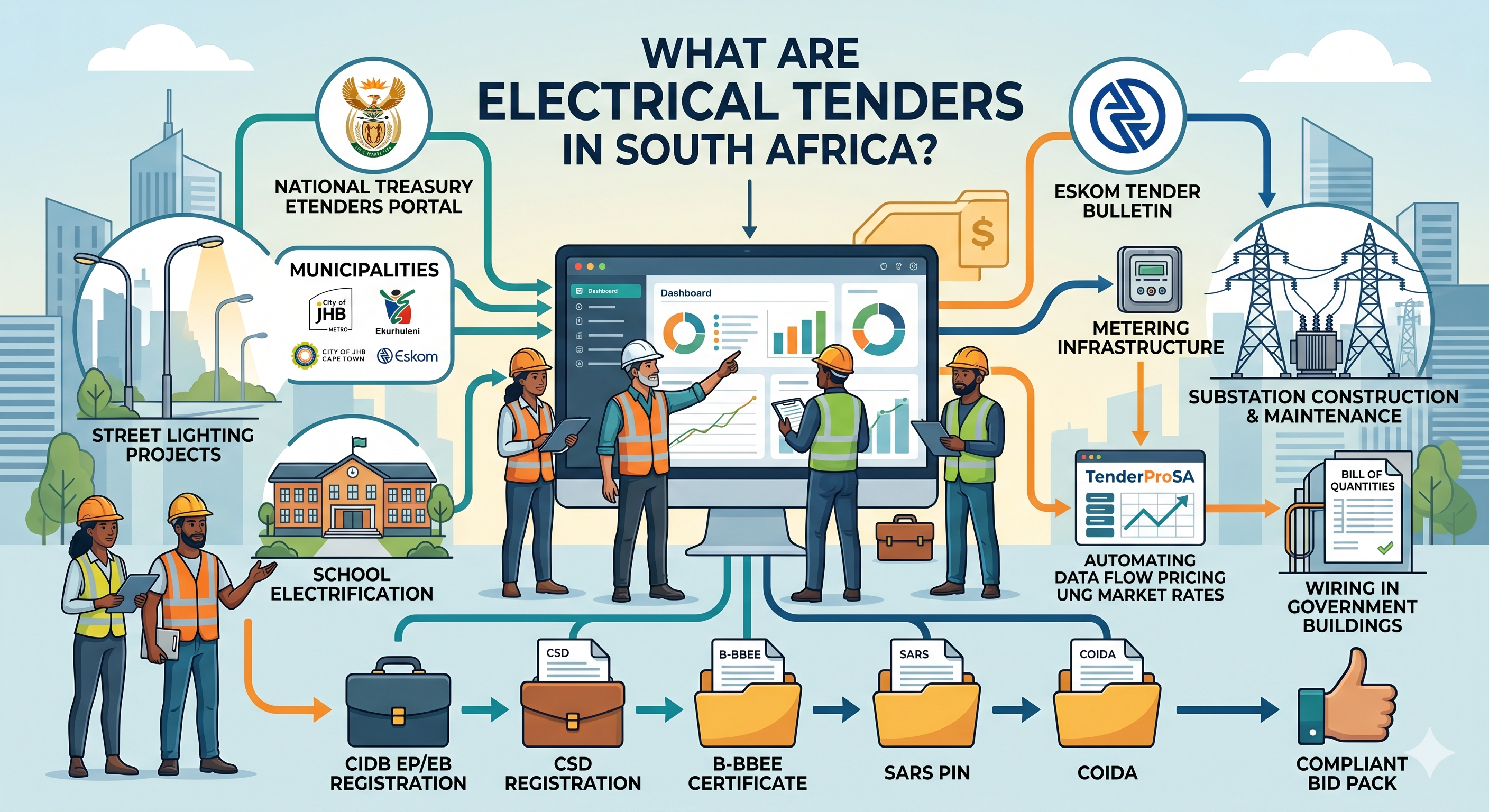
Electrical tenders in South Africa are formal procurement notices issued by government departments, municipalities, state-owned entities such as Eskom, and private sector clients. They invite qualified contractors to submit priced bids for a defined scope of electrical work — from street lighting and school electrification to substation refurbishment and industrial automation projects. If your business holds a valid CIDB EP or EB registration, you are eligible to compete for this stream of work.
In 2026, government electrical tenders remain one of the most consistent procurement categories in South Africa. They are governed by the Public Finance Management Act (PFMA) for national and provincial work, and the Municipal Finance Management Act (MFMA) for local government contracts. Transparency and competition are legally required, which means every qualified contractor — large or small — has a fair shot at winning.
Common categories of electrical tenders include installation and maintenance of wiring and distribution boards in government buildings, high-mast and street lighting projects for municipalities, electrification of clinics, schools, and community facilities, substation construction and maintenance for Eskom or local networks, metering infrastructure, and electrical automation and control systems for industrial or municipal facilities.
Where to Find Open Electrical Tenders in 2026
Many contractors lose out on opportunities simply because they do not know where to look. In South Africa, government electrical tenders are published across several platforms — and monitoring all of them manually is time-consuming.
National Treasury eTenders Portal
The primary official source for government electrical tenders is the National Treasury eTenders portal at etenders.treasury.gov.za. Search for keywords such as "electrical", "EP", "electrification", "lighting", or "switchgear" to surface active opportunities. Filter by province to focus on contracts in your operating area. Most national and provincial department tenders must be published here by law.
Municipal Procurement Portals
South Africa's major metros — City of Johannesburg, City of Cape Town, eThekwini, City of Tshwane, Ekurhuleni, Buffalo City, and Mangaung — all publish tenders on their official websites. Smaller District and Local Municipalities often publish in local newspapers and on municipal notice boards as well as their websites. Ekurhuleni, for example, regularly advertises electrical maintenance and infrastructure contracts separately from general construction tenders.
Eskom's Tender Bulletin
For high-value electrical and substation work, Eskom maintains its own Tender Bulletin at tenderbulletin.eskom.co.za. Eskom awards contracts for distribution infrastructure, metering, fault maintenance, and capital projects. Before you can be considered for any Eskom contract, you must be registered on Eskom's contractor database.
Centralise Your Search with TenderProSA
Checking eTenders, each municipal portal, and Eskom's bulletin daily is not practical for most small businesses. TenderProSA aggregates open electrical tenders from National Treasury, provincial treasuries, municipalities, and Eskom into a single dashboard. Set filters for your province, CIDB grade, and sector, and receive daily alerts for new electrical tender opportunities matched to your profile — so you never miss a contract that fits your business.
CIDB Grading Requirements for Electrical Tenders
Before submitting any government electrical tender, your business must hold a current and valid CIDB registration. For most electrical work, the relevant designation is EP (Electrical Engineering: Buildings and Industry). Infrastructure-heavy work such as overhead lines or large substation projects may fall under EB (Electrical Engineering: Infrastructure).
How the EP Grading Scale Works
CIDB grades run from 1 to 9, with each grade linked to a maximum allowable contract value. The tender specification will always state the minimum grade required — you cannot bid if your grade is lower than specified. To check current rand thresholds for each grade and understand how to upgrade, see our complete CIDB grading guide. As a rule of thumb: Grade 1 EP covers small quotation work; Grades 2–4 cover routine municipal maintenance and small installation projects; Grades 5–7 are mid-to-large infrastructure contracts; Grades 8–9 are reserved for the largest capital projects.
Your CIDB certificate must be valid at the time of bid submission and throughout the contract period. An expired certificate is immediate grounds for disqualification — set a reminder to renew well in advance of your expiry date.
Joint Ventures to Access Higher Grades
If a tender requires a grade your business does not yet hold, you may form a Joint Venture (JV) with another CIDB-registered contractor whose combined grading meets the requirement. Document the JV agreement formally and ensure both parties appear correctly in the bid submission. CIDB has a JV grading calculator on their website.
Beyond your CIDB certificate, government electrical tenders almost always require a current CSD (Central Supplier Database) registration, a valid B-BBEE certificate or sworn affidavit, an active SARS Tax Clearance Pin, and a COIDA Certificate of Good Standing.
How to Price an Electrical Tender Correctly
Pricing is where many contractors win or lose — or win and then lose money on site. Here is a structured approach to pricing electrical tenders accurately.
Understanding the Bill of Quantities
Most electrical tenders include either a preliminary Bill of Quantities (BoQ) prepared by the engineer, or a scope of work document from which you must build your own BoQ. Common line items in electrical BoQs include: supply and installation of cables priced per metre by cable size and type; distribution boards and switchgear (supply and install separately); conduit, trunking, and cable containment; light fittings, MCBs, isolators, and accessories; labour priced by trade and hours; site establishment and supervision under preliminaries; and a contingency allowance.
Using Market-Benchmarked Rates
Pricing from memory is risky. Material costs — particularly copper cable, switchgear, and conduit — fluctuate significantly with the rand and commodity prices. You should benchmark your rates against current market pricing before submitting any bid. TenderProSA's tender automation tool uses market-benchmarked rates to auto-price your electrical BoQ from the documents you upload, reducing manual effort and the risk of costly errors. Labour rates should reflect your current MEIBC (Metal and Engineering Industries Bargaining Council) rates or applicable sectoral determinations.
What Your Price Must Cover
Your submitted price must account for direct material costs, direct labour, subcontractor costs, on-site overheads, head office overheads, and profit margin. For longer contracts, check whether the Special Conditions allow a price adjustment formula — if not, price in a reasonable escalation buffer.
Preparing a Compliant Electrical Tender Submission
A bid that is technically non-compliant — even with the lowest price — will be disqualified. Government procurement regulations require that mandatory documents are present and correctly completed before evaluators consider your price. Do not skip this step.
Mandatory SBD Forms and Compliance Documents
The standard mandatory compliance documents for a South African government electrical tender include: SBD 4 (Declaration of Interest), SBD 6.1 (Preference Point Claim Form, supported by your B-BBEE certificate), SBD 8 (Declaration of Bidder's Past SCM Practices), SBD 9 (Certificate of Independent Bid Determination), a CSD Summary Report printed within its validity period, your CIDB certificate at the required EP grade, a verifiable SARS Tax Compliance Status (TCS) Pin, and a COIDA Certificate of Good Standing. Check each tender's Checklist of Returnable Documents carefully — additional items are common.
Technical Support Documents
Beyond compliance forms, evaluators assess your technical capability. Prepare a contractor profile covering your company overview, relevant past projects, and key personnel CVs. You will also need a Method Statement explaining how you plan to execute the electrical works safely and efficiently, a Health and Safety Plan (including the Section 37(2) agreement), and a Risk Register. TenderProSA generates method statements and risk assessments directly from your uploaded tender documents — so you spend time reviewing rather than writing from scratch.
Common Mistakes That Cost Electrical Contractors Tenders
The most frequent reasons electrical tenders are rejected include: expired CIDB registration; CSD Summary Report printed outside the valid window; missing or unsigned SBD forms; a B-BBEE affidavit not commissioned by a Commissioner of Oaths; and pricing errors where BoQ totals do not match line items. Use a compliance checklist before every submission — TenderProSA's bid pack tool flags missing items automatically before you submit.
Frequently Asked Questions
What CIDB grade do I need to bid on electrical tenders in South Africa?
It depends on the contract value. Government electrical tenders always specify the minimum CIDB grade required under the EP (Electrical Engineering: Buildings and Industry) or EB (Electrical Engineering: Infrastructure) designation. Lower-value municipal work may require Grade 1–3 EP, while larger infrastructure contracts require Grade 5 EP and above. Check the CIDB website for current rand thresholds, and see our CIDB grading guide for a full breakdown.
Where can I find free electrical tenders in South Africa in 2026?
The National Treasury eTenders portal (etenders.treasury.gov.za) publishes government electrical tenders for free. Municipal procurement portals and Eskom's Tender Bulletin are also free to access. TenderProSA aggregates these sources into one dashboard with sector and province filters, so you can monitor all opportunities without visiting multiple websites every day.
Do I need a CIDB registration for private sector electrical work?
CIDB registration is legally required for government projects above the applicable threshold. Private sector clients are not obliged to require it, but many large companies and SOEs do as a quality standard. If government tendering is part of your growth plan, securing your CIDB EP registration early is the right move.
How long does it take to prepare a complete electrical tender bid?
A straightforward electrical tender bid — with compliance documents already in order — typically takes one to three days to prepare properly: reading and annotating the tender document, building or completing the BoQ, drafting the method statement, compiling compliance documents, and doing a final checklist review. Using a platform like TenderProSA can reduce this significantly by auto-generating the BoQ pricing, method statement, and compliance checklist from your uploaded tender documents.
What is the difference between EP and EB CIDB grading for electrical contractors?
EP (Electrical Engineering: Buildings and Industry) covers electrical installations in buildings, factories, commercial premises, and related infrastructure — the most common designation for general electrical contractors. EB (Electrical Engineering: Infrastructure) covers larger-scale electrical infrastructure such as high-voltage overhead transmission lines, major substations, and bulk supply points. Some contractors hold both designations. Check the specific tender scope carefully to confirm which designation applies before bidding.
Can I use AI to help write my electrical tender bid?
Yes — AI tools built for South African tendering can significantly reduce bid preparation time. TenderProSA reads your uploaded tender document, prices the BoQ using market-benchmarked rates, and generates supporting documents including method statements and compliance checklists — so your team reviews rather than builds from scratch on every bid.
Ready to win more electrical tenders with less effort? TenderProSA analyses your tender documents, prices your electrical BoQ with market-benchmarked rates, and generates a complete, compliant bid pack — so you can submit more tenders, faster, and with greater accuracy.