
How to Compile a Tender Bid Pack in SA (2026)
What Is a Tender Bid Pack?
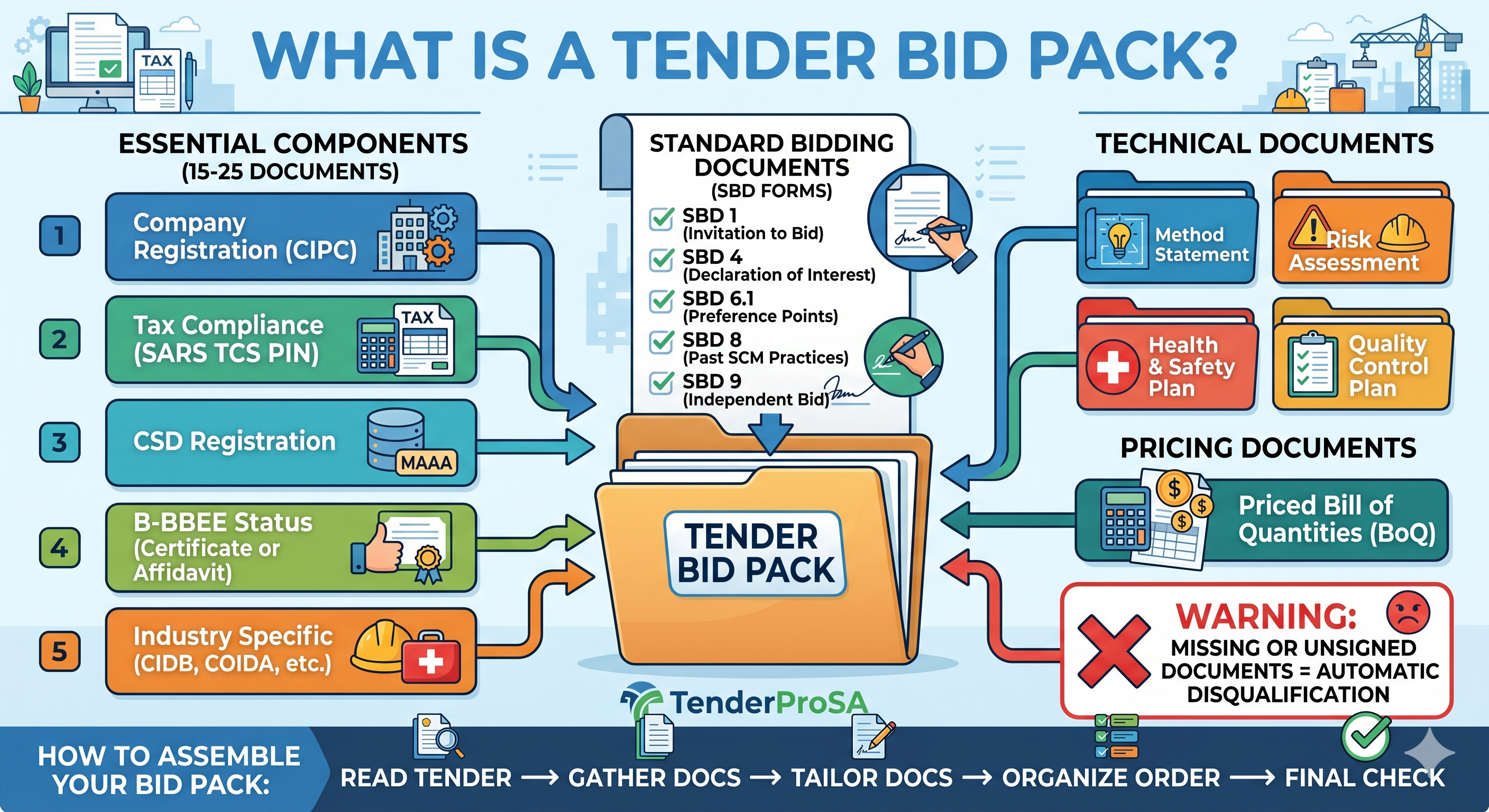
A tender bid pack is the complete set of documents you submit in response to a government tender. It's not just your price — it's everything the evaluation committee needs to assess your company's capability, compliance, and competitiveness. In South African public procurement, a missing document or unsigned form is grounds for automatic disqualification, no matter how good your price is.
The typical SA government bid pack contains 15-25 separate documents spanning company registration, tax compliance, B-BBEE status, technical capability, pricing, and administrative forms. Getting them all right, current, and correctly assembled is where most SMMEs struggle — and where most tenders are lost before a single line of the BoQ is even evaluated.
This guide covers every document you need, in the order you should compile them, with tips on the mistakes that trip up SA contractors every day.
The Complete Bid Pack Document Checklist
Every government tender is different, but the core document set follows the National Treasury Standard Bidding Documents framework. Here's what you'll need for almost every tender:
1. Company Registration Documents
- CIPC Certificate of Incorporation (CoR 14.3 for Pty Ltd) — must be current, not the original registration certificate
- Company profile — 2-4 pages covering your history, capabilities, key personnel, and relevant project experience
- Directors' certified ID copies — certified within the last 3 months by a Commissioner of Oaths. Expired certifications are a common rejection reason.
- Share certificates — for verification of ownership, especially important for B-BBEE claims
2. Tax and Financial Compliance
- SARS Tax Compliance Status (TCS) PIN — the 10-digit PIN that allows real-time verification. The old paper tax clearance certificate is no longer accepted.
- CSD registration — your Central Supplier Database report with MAAA supplier number. Must show active status with no compliance flags.
- Latest audited financial statements — usually required for tenders above R10 million, or as specified. Compiled statements may be accepted for smaller tenders.
- Proof of banking — a bank confirmation letter (not older than 3 months) or cancelled cheque
3. Industry Registrations
- CIDB registration — mandatory for all construction-related tenders. Your grading must match or exceed the tender value and class of works specified.
- COIDA letter of good standing — proof of Compensation for Occupational Injuries and Diseases Act registration and good standing
- B-BBEE certificate — either a SANAS-accredited verification certificate (for EMEs with turnover above R10 million) or a sworn affidavit (for EMEs below R10 million and QSEs)
- Industry-specific registrations — PSIRA for security, NHBRC for home building, relevant trade certificates for electrical or plumbing work
4. Standard Bidding Documents (SBD Forms)
These are the National Treasury forms that every bidder must complete. Missing even one is fatal:
| Form | Name | Purpose |
|---|---|---|
| SBD 1 | Invitation to Bid | Your formal acceptance of the tender terms. Must be signed by an authorised representative. |
| SBD 2 | Tax Reference Number | Declares your tax registration details. Now largely replaced by the TCS PIN verification. |
| SBD 3.1 | Pricing Schedule (Fixed) | Your firm, non-negotiable pricing. Used for supply tenders. |
| SBD 4 | Declaration of Interest | Declares any conflicts of interest, relationships with government employees, or previous convictions. |
| SBD 6.1 | Preference Points Claim | Your B-BBEE level claim under the 80/20 or 90/10 PPPFA preference system. Must match your certificate. |
| SBD 8 | Declaration of Past SCM Practices | Declares no involvement in corrupt or fraudulent supply chain management practices. |
| SBD 9 | Certificate of Independent Bid | Certifies your bid was prepared independently without collusion with other bidders. |
Every SBD form must be completed in full, signed, and dated. Blank fields should be marked "N/A" — never leave them empty.
5. Technical Documents
- Method statement — describes how you'll execute the work, step by step. Required for all construction and service delivery tenders.
- Risk assessment (HIRA) — Hazard Identification and Risk Assessment per OHSA Construction Regulations 2014
- Health and Safety Plan — outlines your H&S management approach, PPE provisions, emergency procedures, and site safety rules
- Quality Control Plan — inspection and test plans (ITPs), hold points, and quality management procedures
- Project programme — Gantt chart or similar showing planned activities, milestones, and completion timeline
- CVs of key personnel — qualifications and experience of site agent, foreman, safety officer, and any specialists
6. Pricing Documents
- Priced Bill of Quantities — every line item priced with rate and amount. Arithmetic must be correct. Pages must be initialled.
- Pricing summary — subtotals per section, VAT calculation (15%), and grand total
- Proof of pricing methodology — some tenders request evidence of how rates were derived (supplier quotes, wage schedules)
How to Assemble Your Bid Pack — Step by Step
Compiling a bid pack isn't just about having the documents — it's about presenting them correctly. Here's the process:
Step 1: Read the Entire Tender Document First
Before you touch a single form, read the tender cover to cover. Pay attention to:
- The mandatory requirements section — this tells you exactly what must be in the pack and in what order
- The evaluation criteria — functionality, price, and preference weightings. This tells you where to focus your effort.
- The returnable documents schedule — the definitive list of what to submit. If it's on this list and not in your pack, you're disqualified.
- Closing date, time, and delivery address — late submissions are never accepted, regardless of reason
Step 2: Gather Evergreen Documents
Keep a "tender-ready" folder with documents that don't change between bids:
- CIPC registration certificate
- B-BBEE certificate or affidavit (update annually)
- CIDB registration certificate (check expiry date)
- COIDA letter of good standing (annual renewal)
- Company profile
- Key personnel CVs
Check expiry dates on every document before including it. An expired CIDB registration or COIDA certificate renders your entire bid non-responsive.
Step 3: Prepare Tender-Specific Documents
These must be customised for each tender:
- All SBD forms — completed with the specific tender reference number and project details
- Method statement — tailored to the specific scope of work, site conditions, and technical specifications
- Risk assessment — addressing hazards specific to this project and site
- Project programme — based on the contract duration and milestones specified
- Priced BoQ — with rates specific to this project's location, conditions, and requirements
Step 4: Compile in the Required Order
Most tenders specify the order. If not, use this standard sequence:
- Cover letter on company letterhead
- Returnable documents schedule (checklist — tick off each item)
- SBD forms (1, 2, 3.1, 4, 6.1, 8, 9)
- Tax compliance (TCS PIN / CSD report)
- Company registration and B-BBEE
- CIDB registration
- COIDA letter of good standing
- Company profile and CVs
- Method statement
- Risk assessment and H&S plan
- Quality control plan
- Project programme
- Priced Bill of Quantities
- Any additional annexures or supporting documents
Step 5: Final Quality Check
Before sealing the envelope or uploading to the eTender portal:
- Every form signed and dated — check every signature line on every document
- Every page of the BoQ initialled
- All dates current — no documents with dates after the closing date
- Correct number of copies — most tenders require an original plus 1-2 copies. Some require a separate sealed pricing envelope.
- Electronic submission formatted correctly — PDF format, within file size limits, all pages legible
The 7 Most Common Bid Pack Mistakes
These are the errors we see South African contractors make repeatedly:
| # | Mistake | Result |
|---|---|---|
| 1 | Missing SBD form signature | Automatic disqualification — non-responsive bid |
| 2 | Expired CIDB registration | Bid rejected at compliance check |
| 3 | B-BBEE level doesn't match SBD 6.1 claim | Preference points reduced or bid disqualified for misrepresentation |
| 4 | Certified ID copies older than 3 months | Documents considered invalid — bid may be rejected |
| 5 | BoQ arithmetic errors | Evaluated on corrected totals (may price you out) or rejected |
| 6 | Generic method statement not tailored to tender | Low functionality score — lose on technical evaluation |
| 7 | Late submission (even by 1 minute) | Rejected at the door — no exceptions under PPPFA regulations |
How PPPFA Points Affect Your Bid Pack
Under the Preferential Procurement Policy Framework Act, every government tender is evaluated on a points system:
- 80/20 system (tenders up to R50 million): 80 points for price, 20 points for B-BBEE preference
- 90/10 system (tenders above R50 million): 90 points for price, 10 points for B-BBEE preference
This means a Level 1 B-BBEE contributor gets the full 20 (or 10) preference points — a significant advantage. If your price is within 20% of the lowest bidder and you have superior B-BBEE credentials, you can still win. This is why the SBD 6.1 form and a valid B-BBEE certificate are critical components of your bid pack.
Some tenders also include functionality evaluation — scored on criteria like methodology, experience, key personnel qualifications, and project approach. Bidders who don't meet the minimum functionality threshold (typically 60-70 points) are eliminated before price is even considered.
Digital vs Physical Submission
South African government procurement is increasingly moving online via the eTender portal and departmental procurement systems. Key differences:
- Physical submission: Print, bind, seal in envelope, deliver to tender box before closing time. Label envelope with tender number and description.
- eTender portal: Upload PDFs, complete online forms, submit before system closes. Ensure file sizes are within limits (typically 5-10MB per document). The system does not accept late uploads.
Regardless of format, keep a complete copy of everything you submit. You may need it for queries, presentations, or dispute resolution.
How TenderProSA Automates Your Bid Pack
Manual bid pack compilation takes 3-7 days per tender. You're chasing documents, filling forms, writing method statements from scratch, and hoping nothing falls through the cracks.
TenderProSA automates the entire process:
- Upload your tender documents — AI extracts all requirements, deadlines, and document checklist items
- Auto-generate compliance documents — method statements, risk assessments, H&S plans, and quality control plans tailored to the specific tender scope
- BoQ pricing — AI-powered pricing with market-benchmarked rates, automatic calculations, and error checking
- Bid pack assembly — all documents compiled in the correct order with a compliance checklist showing green/red status for every required item
- Supplier RFQ management — get subcontractor and material quotes directly through the platform
Instead of spending a week on one tender, you can compile and submit in hours — and bid on more opportunities.
Frequently Asked Questions
What documents do I need for a government tender bid pack?
A complete SA government bid pack typically includes: CIPC registration, SARS TCS PIN, CSD report, CIDB certificate, COIDA letter, B-BBEE certificate, all SBD forms (1, 3.1, 4, 6.1, 8, 9), method statement, risk assessment, H&S plan, quality control plan, project programme, priced BoQ, company profile, and directors' certified ID copies. The specific requirements are listed in each tender's returnable documents schedule.
What is the most common reason tenders get disqualified?
Missing or incomplete SBD forms are the #1 disqualification reason. Other common causes include unsigned documents, expired compliance certificates (CIDB, COIDA, B-BBEE), arithmetic errors in the BoQ, and late submission. Always use the returnable documents schedule as your final checklist before submitting.
How long does it take to compile a tender bid pack?
Manual compilation typically takes 3-7 working days depending on tender complexity — gathering documents, completing forms, writing the method statement, pricing the BoQ, and doing quality checks. With AI automation tools like TenderProSA, this can be reduced to a few hours.
Do I need a method statement for every tender?
Yes, for virtually all construction and service delivery tenders. The method statement describes your planned approach to executing the work and is scored as part of the functionality evaluation. Generic method statements score poorly — always tailor yours to the specific project scope, site conditions, and technical specifications.
What B-BBEE level do I need to win government tenders?
You don't need a specific level to bid, but your B-BBEE status directly affects your preference points under the PPPFA. Level 1 contributors get the maximum 20 points (80/20 system) or 10 points (90/10 system). Even if your price is slightly higher, strong B-BBEE credentials can help you win. EMEs with turnover below R10 million can use a sworn affidavit instead of a verification certificate.
Can I submit a government tender electronically?
Increasingly, yes. National and provincial departments are moving to the eTender portal and other electronic submission systems. However, many municipal and SOE tenders still require physical submission to a tender box. Always check the specific tender document for submission instructions, format requirements, and file size limits.
Ready to compile your next bid pack in hours instead of days? Try TenderProSA free today — upload your tender documents and get AI-powered document generation, BoQ pricing, and compliance checking.